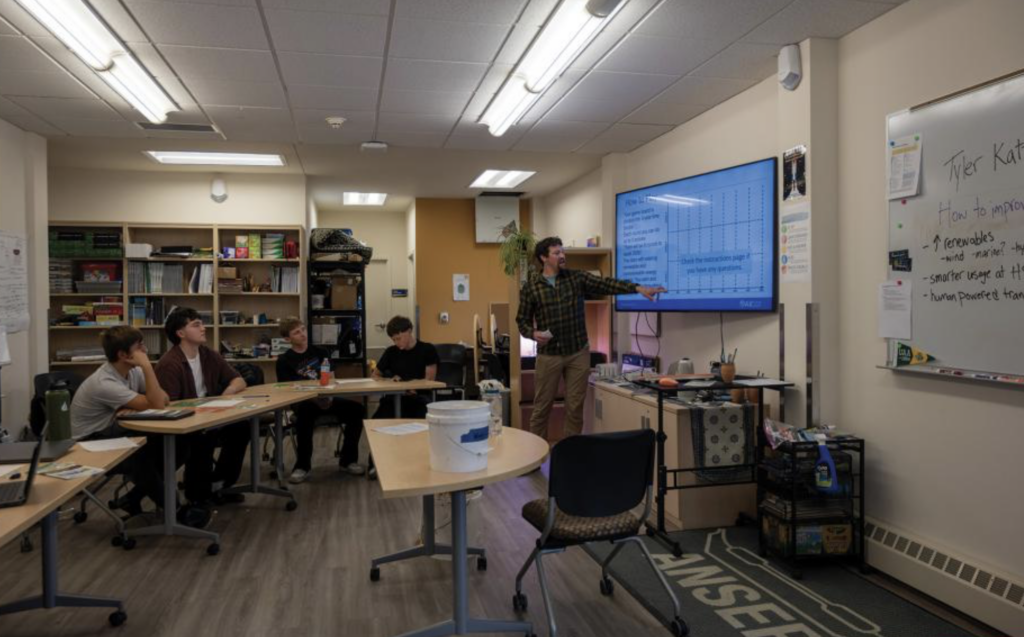
Last Friday, in a parking lot behind the UAF Northwest Campus, a group of Nome ANSEP Acceleration Academy students next to a bright orange van were working to assemble a basketball hoop. Inside, other students were quietly working on classwork. Last year, a group of parents got together, fundraising about $100,000 to start Nome’s ANSEP Acceleration Academy. ANSEP is funded through the State of Alaska, University of Alaska, and donations from strategic community, corporate, and philanthropic partners.
Eleven students started last year at the Nome-Beltz Middle High School campus. This year, the program has 16 students and had relocated to a bright, warm building at the UAF Northwest Campus. ANSEP, which stands for Alaska Native Science and Engineering Program, is a program that started in the mid-1990s as a scholarship opportunity for one Alaska Native student. Now, it has grown to provide programs for students from kindergarten to a PhD.
The students at Nome’s ANSEP Acceleration Academy are enrolled at Nome Public Schools and are full-time university students. “Monday through Thursday are classes, and then our Fridays are cultural, art, STEM, community engagement, community service – students have 20 hours of community service every semester to finish and complete,” said Academy Director Kacey Miller. Students take college courses that also count for high school graduation requirements. “It’s called an acceleration academy because they’re accelerating through the high school graduation requirements so much quicker than out at Beltz,” explained Miller.
Jimmy Nderitu, a senior, is in his second year at ANSEP, and said the courses at ANSEP offer a different set of challenges than what he took before. “They’re not harder, but there’s more you need to do,” he said. “You need to be dialed in because if you just rest easy, you won’t get the job done, and you might just kind of fall out of it. So you just gotta be locked in most of the time.”
Max Breuker is a freshman, in his first year at ANSEP. He has a different take. Breuker said the courses are more difficult than his middle school courses, but still enjoyable. “Getting to do work on your own time – that’s nice, as long as you’re on top of it, because that gives you a lot of free time if you complete your assignments early,” he said. “I’ve learned to not procrastinate as much.”
Both students said ANSEP offers a lot more freedom, but with that comes a lot more personal responsibility. “It definitely puts a lot more pressure on you as a freshman, but I feel like that’s just going to get easier over time,” said Breuker.
The responsibility is worth it to them. By being dual-enrolled, the students will hit their high school graduation with many of their college courses out of the way. Breuker said he’ll be able to graduate high school with an associate’s degree. Nderitu wants to be a psychologist. By being dual-enrolled, he’s got that much more college coursework under his belt before he graduates high school. “They’re open to help me personally to reach my goal,” he said. “It’s like accelerating at a super high rate.”
Despite being located off-campus, the students at the acceleration academy are still active in the Nome-Beltz community. Many of the ANSEP students are on student council, participate in sports and were honored at Nome-Beltz’ Honor Roll Luncheon last week. Nderitu said that he does not feel like he’s missing out by not being at Nome-Beltz. “We do get to go over there for events, lunchtime,” he said. “We still do interact with them.”
Out of the 43 students honored at the Honor Roll Luncheon, eight were ANSEP students. Nome-Beltz does not weight GPAs, so the four ANSEP students that achieved a 4.0 last semester – Renee Brown, Sage Gregg, Levi Pederson and Rose Paniptchuk – earned straight As in their college courses. ANSEP students are allowed to be as involved with the Nome-Beltz community as much as they want, and the program tries to drive decision making by what the students prefer. “It’s an optional lunch. If they want to go to Beltz, they can. If they want to stay here, they can,” explained Miller. “We have an open campus. If they want to take electives at Beltz, they can. We can work around their schedules and do as much as we can to reflect that.”
The students aren’t on their own. Students at the acceleration academy have access to the same resources university students at the UAF campus have, as well as ANSEP-specific resources like a counselor. “We understand it’s an additional responsibility when you’re a young individual taking college level courses,” said Miller. “It’s definitely a multi-faceted support approach for students.”
“There’s some freedom and liberty and responsibilities, but we also have some programmatic requirements where you have to keep working with a tutor when you’re taking a math class,” added Miller.
This story is written by Ariana Crockett O’Harra and originally published on the Nome Nugget. Read the article on the Nome Nugget here.